
(Report prepared by Labiba Bashar)
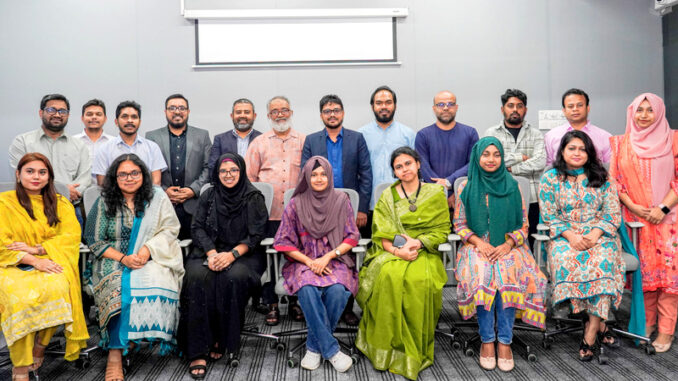
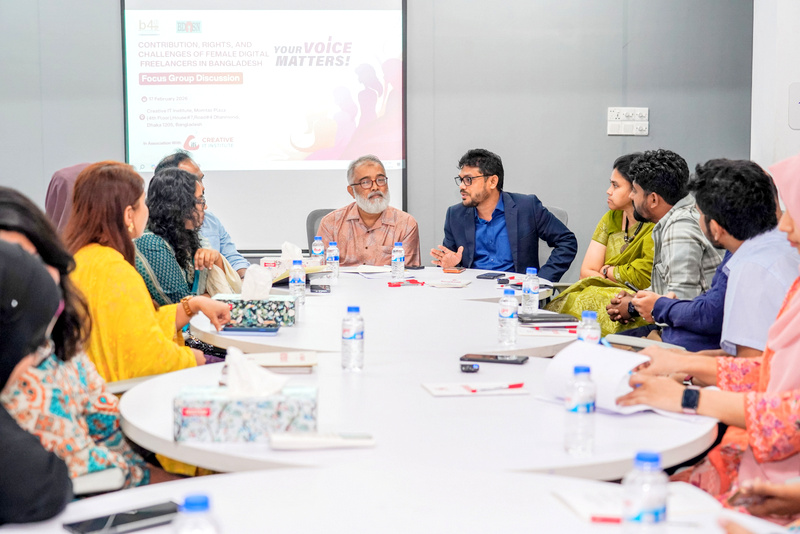
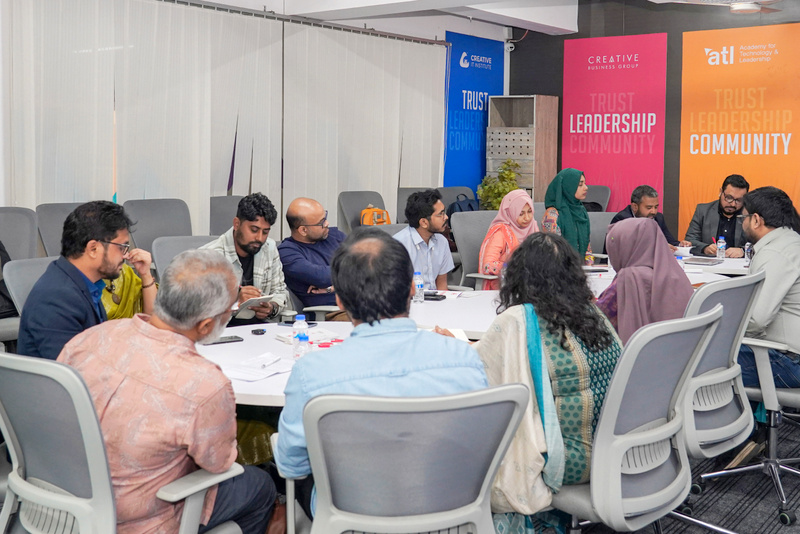
Bytesforall Bangladesh initiated a study project on female freelancers in Bangladesh to address the research gap in understanding the community of female freelancers, their realities, contribution, rights and challenges. As part of that process, on February 17, 2026, it organized the 2nd focus group discussion (FGD) in collaboration with Bangladesh Open Source Network (BdOSN) and Association of Progressive Communication (APC), where a total of 19 stakeholders from diverse professional and organizational backgrounds of female freelancing eco-system participated. The meeting was held at Creative IT Office, Dhaka, Bangladesh. The 1st focus group discussion (FGD) was held on February 4, 2026, where a number of female freelancers have been invited to share their experiences and views. As we heard directly from the female freelancers, the objective of the 2nd FGD was to explore the challenges and opportunities of female freelancers from other support groups in the eco-system such as, digital rights activists, gender specialists, media, freelancing training experts, platform organizers, community leaders etc.
Following are the people who joined the 2nd FGD.
- Abdullah Titiv is working as the Head of Research at Digitally Right.
- Halima Akter Jerin is associated with GP Academy (Student)
- Yasin Ahmed is serving as a UI/UX Instructor at GP Academy.
- Muntasir Hasnat is also affiliated with GP Academy, where he works as a WordPress Instructor.
- Arif Mainuddin is the Managing Director of Decodes Lab Ltd.
- Rahitul Islam is working as a Writer and Reporter at Prothom Alo.
- Emrazina Islam is associated with Kaz360 and Emrazina Technologies, where she works as a Graphic Designer and Entrepreneur.
- Kazi Mamun is employed as a Web Developer and Entrepreneur at Team Mavin.
- Promi Nahid serves as the Treasurer of BDOSN and is also the CEO of Zero Degree Communication.
- Nazib Rafe is working as the CEO of WIT Institute.
- Zia Uddin Mahmud is serving as the Chief Operating Officer (COO) of Creative IT Institute.
- Shohidur Rahman is working as an AGM at Creative IT.
- Tanzila Akter is a student of the University of Dhaka (DU).
- Mosharraf Hasan Tipu is working as a Program Officer.
- Munir Hasan is serving as the President of BDOSN and coordinator for Bytesforall Bangladesh
- Tanjila is working as a Graphic Designer.
- Rokaiya Haque Umama is employed as a UX/UI Designer.
- Rifah Tamanna Aurpa is working as a Digital Marketer.
- Monir Hosen is serving as the Chairman of Creative Business Group
- Partha Sarker, Co-founder of Bytesforall Bangladesh helped prepare the questionnaire and discussion topics.
Women’s Participation and Contribution
The discussion highlighted that female digital freelancers contribute significantly to household income, skill-based employment, and Bangladesh’s participation in the global digital economy, yet their contributions remain under-recognized. Monir Hossain, Chairman of Creative Business Group, noted that women’s engagement has not grown in proportion to their potential, stating, “The number and capacity of female freelancers in Bangladesh are not increasing at the desired rate. Without coordinated efforts in training, market linkage, and visible role models, women’s participation will remain limited.” This observation indicates that structural and visibility-related barriers, rather than lack of ability, restrict women’s contribution to the sector.
Training Experience and High Dropout Rates
A consistent finding from the FGD was the high dropout rate among female trainees despite strong initial motivation. Nazib Rafe, CEO of WIT Institute, explained, “At the beginning of training, female students are highly enthusiastic and attentive, but their dropout rate is much higher and success rate lower.” He further noted that women often do not receive the opportunity to try again after early failure, adding, “Family and social environments rarely allow women a second attempt.” This suggests that discontinuation is driven less by skill gaps and more by social constraints and the absence of sustained mentorship.
Online Learning: Opportunity with Limitations
Online learning was widely viewed as beneficial for women, particularly married participants, due to flexibility. Yasin Ahmed, UI/UX Instructor at GP Academy, stated, “Online classes are a major advantage for women because time management is a critical issue for them.” However, he also reported that “between 40 and 80 percent of female students drop out during the course due to family pressure.” This finding reveals that flexibility alone is insufficient unless accompanied by family awareness and long-term support mechanisms.
Knowledge Gaps and Platform Navigation Challenges
Several female participants identified significant gaps in platform-related knowledge. Tanjila Akter, a UX/UI freelancer and University of Dhaka student, shared, “I did not fully understand how Fiverr worked when I started, and my account was banned twice due to my own mistakes.” She added that she initially underestimated the importance of portfolios, noting, “Only after clients started asking did I realize how critical a portfolio is.” This highlights the need for structured guidance on platform compliance, account safety, and professional branding for women entering freelancing.
Gender-Based Discrimination in Client Engagement
Gender bias emerged as a major theme, particularly in local markets. Halima Akter Jerin stated, “Because I am a woman, I have to put in more effort than male freelancers to convince clients that I am capable.” She further noted that such bias exists in both local and global markets, though it is more pronounced locally. This finding suggests that gendered assumptions about competence continue to undermine women’s professional credibility in digital workspaces.
Safety and Accessibility of Training Environments
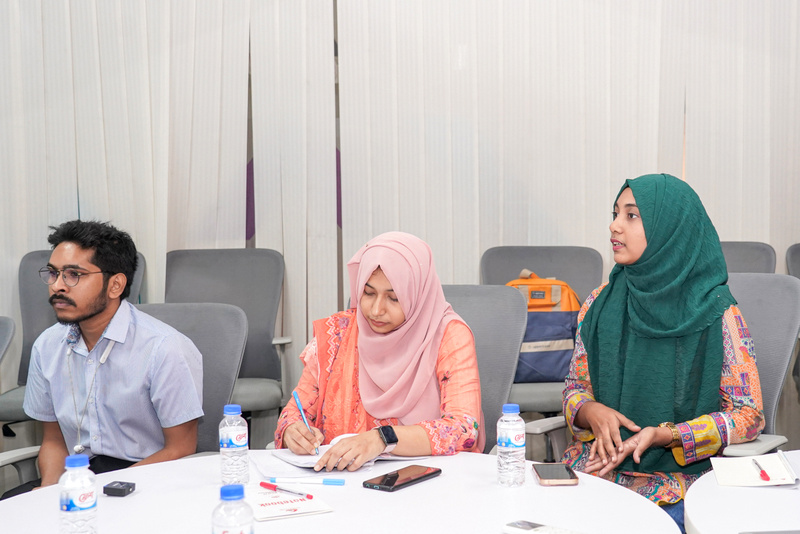
Concerns about physical safety and accessibility were also raised. Emrazina Islam, a graphic designer and entrepreneur, described being discouraged from enrolling in an offline UX/UI course, stating, “I was told the training location was not safe for women at night and that I should bring a male companion.” She explained that this ultimately prevented her from enrolling. This reflects how safety concerns and gender norms restrict women’s access to advanced skill development opportunities.
Family Support and Investment Barriers
Participants emphasized that women face greater difficulty securing financial and emotional support from families. One female participant stated, “My family is unwilling to invest in my freelancing career, but they would support the same investment for a male family member.” Supporting this, Monir Hossain observed that “women are more likely to lack basic tools such as laptops, which limits their ability to utilize training opportunities.” This finding underscores the role of unequal household investment in widening gender gaps in freelancing success.
Balancing Domestic Responsibilities and Professional Work
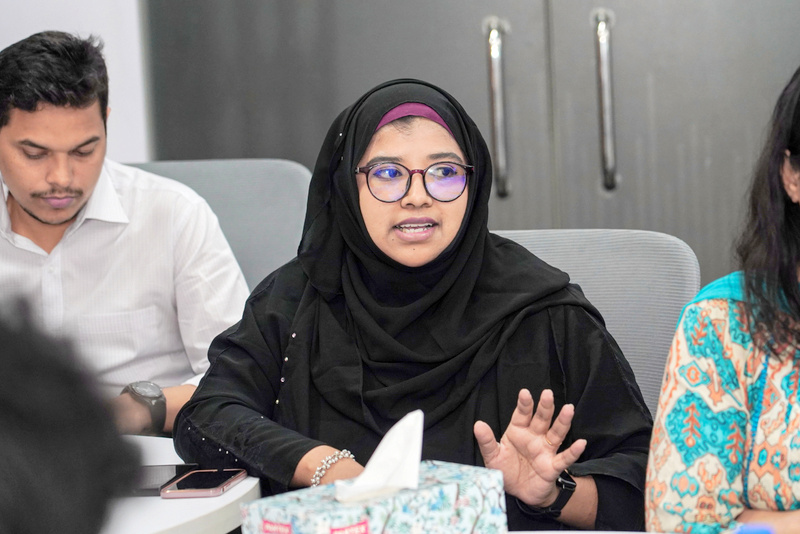
Domestic workload was identified as a key barrier to career continuity. Ziauddin Mahmud, COO of Creative IT Institute, noted, “A woman working from home cannot dedicate the same uninterrupted time as a man because she must manage household duties alongside freelancing.” This illustrates how unpaid care work directly reduces women’s capacity to compete equally in the digital labor market.
Legal Protection and Rights Awareness
The absence of legal safeguards was widely discussed. Abdullah Titir, Head of Research at Digitally Right, stated, “Freelancing is treated as informal work, so there is no clear legal framework to address harassment or labor rights violations.” This finding indicates that female freelancers remain particularly vulnerable to online harassment, exploitation, and non-payment due to weak institutional protection.
Payment Security and Risk of Exploitation
Payment insecurity emerged as a critical concern. Emrazina Islam pointed out, “Local marketplaces cannot operate escrow systems, allowing buyers to disappear after receiving work without paying.” Participants agreed that without secure payment mechanisms, female freelancers face heightened financial risk, especially in local markets.
Overall Findings
The FGD findings indicate that while female digital freelancers in Bangladesh possess strong potential and contribute meaningfully to economic activity, their progress is constrained by social norms, family expectations, limited access to resources, gender-based discrimination, weak legal protection, and inadequate institutional support. The integration of participant experiences and expert insights demonstrates that addressing these challenges requires not only skill development but also systemic changes in policy, legal frameworks, community support, and societal attitudes.