
(Report prepared by Labiba Bashar)
1. Context and Background
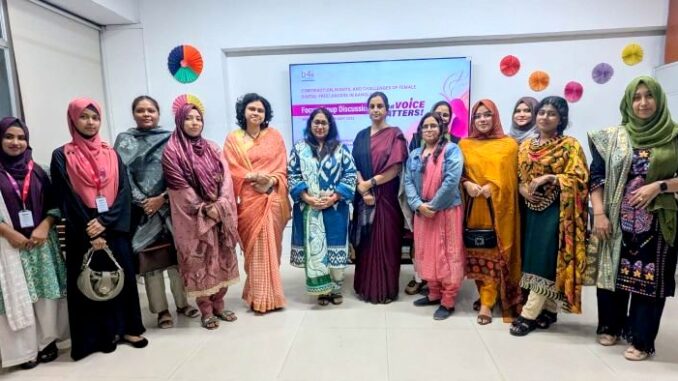
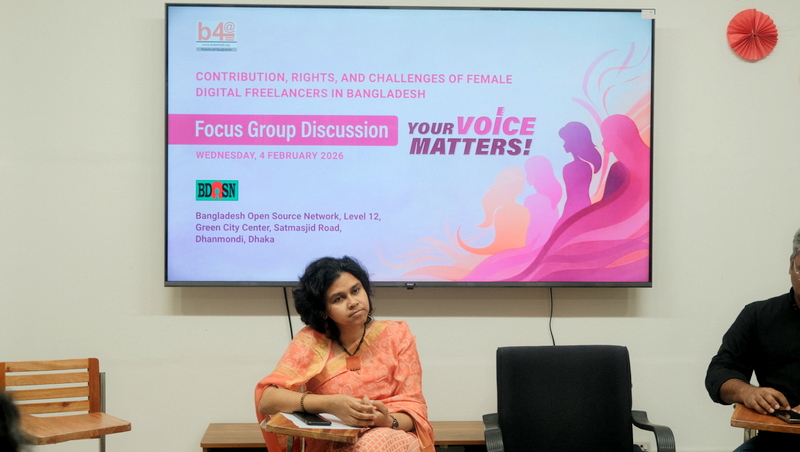
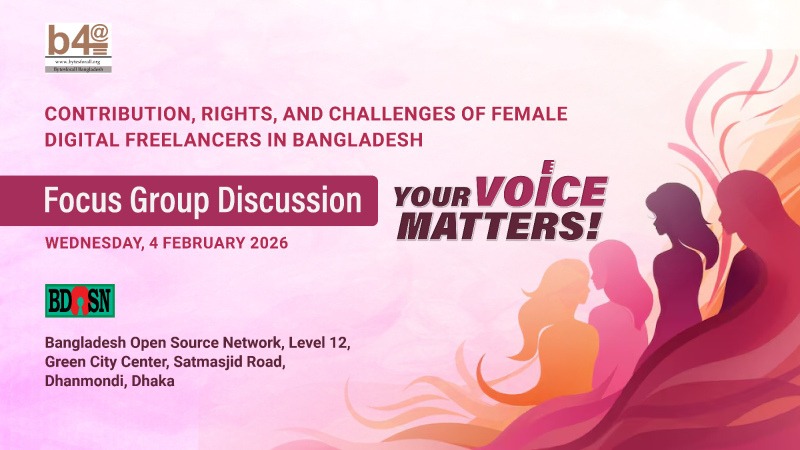
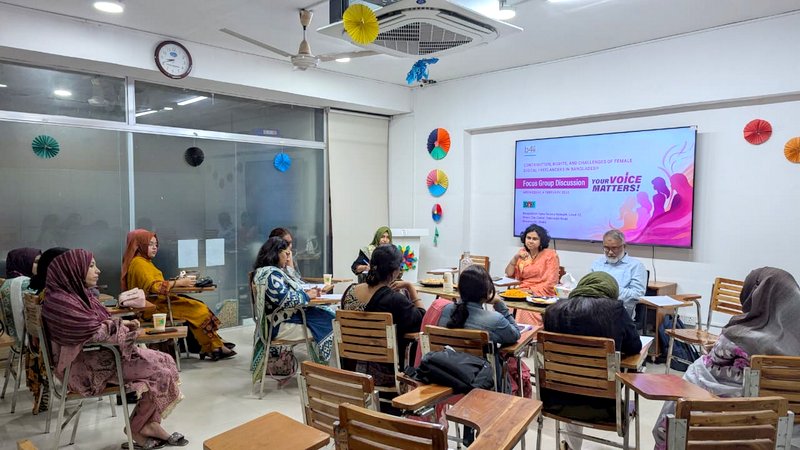
Bytesforall Bangladesh initiated a study project on female freelancers in Bangladesh to address the research gap in understanding the community of female freelancers, their realities, contribution, rights and challenges. As part of that process, on February 4, 2026, it organized its first focus group discussion (FGD) in collaboration with Bangladesh Open Source Network (BdOSN) and supported by Association for Progressive Communication (APC). A number of female freelancers have been invited to its office to share their experiences and views. Its a mixed method strategy where a number of FGDs together with in-depth interviews and a survey are being conducted with a chosen group of independent freelancers and stakeholders.
2. The FGD’s objectives
The following were the main goals of the focus group discussion:
- Determine the kinds of assistance that women independent freelancers require in order to maintain and advance their professions.
- Recognize the main obstacles and difficulties people encounter at work.
- Examine the larger systemic, technological, and social challenges facing the freelance industry.
3. Profile of Participants
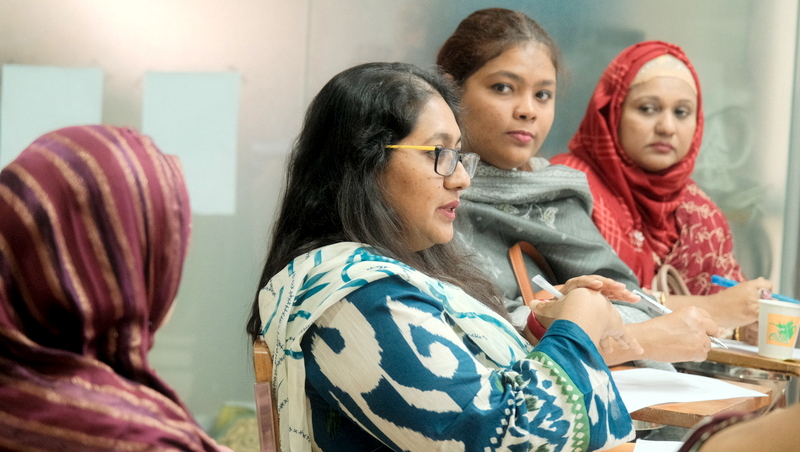
The FGD included 13 female freelancers engaged across diverse digital platforms and service areas:
- Emrazina Islam, founder of Emrazina Technologies & Kaz360, has been freelancing since 2011 and works as a graphic designer on Upwork.
- Nadira Shakil, a multitasker, works as a designer on Designhill. She previously worked in SEO but shifted fields as it did not suit her. She is also employed at a special school and has worked with over 57 international brands.
- Shormin Akter has been working on Designhill for the past 2–3 years as a graphic designer, focusing on design-related services.
- Misty Chowdhury has been working in UI/UX design for the past 1.5 years. She previously worked as a web developer but had to stop due to family issues. Later, she shifted to UI/UX design and currently works remotely. She also tried graphic design but found it too time-intensive to manage alongside family responsibilities.
- Azanta Reewana has been freelancing since 2013 through Upwork, initially in content writing and currently as a fiction content writer.
- Sadia Binte Islam has been freelancing since 2021, even before completing her graduation. She works on both Upwork and Fiverr with international clients and specializes in digital marketing, website maintenance and customization, and email automation.
- Fatema Akter secures projects through Facebook groups and YouTube. She is also a teacher and shared that she joined the session as an effort to step outside her comfort zone.
- Syeda Sumi Akhter works through Facebook pages.
- Rabeya Jaben specializes in Google Ads and works with the agency where she received her training. She also leads a team.
- Saima Rahman is a digital marketing student.
- Shohagi Akter works as a graphic designer student.
- Mst. Farzana Akter is engaged in web design and development student. .
- Nusrat Zahan works in the field of digital marketing student.
- Partha Sarker, co-founder of Bytesforall Bangladesh helped prepared the thematic issues and the questionnaire for the FGD.
Together, these participants represent a wide range of platforms, skills, and professional trajectories within Bangladesh’s digital freelancing sector.
4. Key Discussion Findings
4.1 Market Saturation and Decline in Work Quality
Many participants stated that the freelancing market has become overly saturated, resulting in a noticeable decline in work quality. Several participants observed that there are now more individuals copying work and fewer professionals creating original content or programming solutions.
The rapid adoption of AI tools, particularly premium AI versions, has further intensified this issue. Most beginner-level tasks are now being completed using AI, which has led to a significant drop-out of beginner freelancers. AI usage has also increased the tendency to copy content rather than produce original work.
Since AI-generated outputs are often repetitive and similar in nature, professional organizations and quality-focused clients now prefer hiring only experienced freelancers. Others choose to rely on free AI tools instead of hiring freelancers.
4.2 Client Expectations and AI Pressure
Participants reported that many clients now seek suggestions from AI first and then instruct freelancers to deliver exactly what the AI produces. This creates excessive pressure, as freelancers are expected to replicate AI outputs precisely. The challenge is particularly severe when client’s especially older clients do not understand the limitations of AI and demand exact matches.
4.3 Content Writing and Changing Consumption Habits
Content writers emphasized that their declining work opportunities are not solely due to AI but rather due to a decrease in reading habits. Written content now holds value mainly when converted into video or audio formats. One content writer shared that this shift has forced her to transition into fiction writing.
4.4 Gender Identity Misuse and Platform Abuse
Some participants highlighted instances where male freelancers open accounts using their wives’ identities to secure work. In some cases, men whose accounts have been blocked create new profiles under their wives’ names, misusing female identities within freelancing platforms.
4.5 Access to Learning Resources and Networking Gaps
Female freelancers reported significant difficulties in finding authentic learning resources due to misleading click bait content and irrelevant videos. While men tend to have stronger professional networks due to greater mobility and social interaction, women often work from home, resulting in limited networking opportunities and weaker access to information.
Participants also noted that AI frequently provides inaccurate or misleading information without proper verification.
4.6 Work Habits and Declining Patience
Participants observed that patience levels have declined significantly in the current era. People struggle to consume long-form content without skipping. Freelancers often multitask, and late-night work is commonly accompanied by music or audiobooks.
5. Mentor’s Perspective
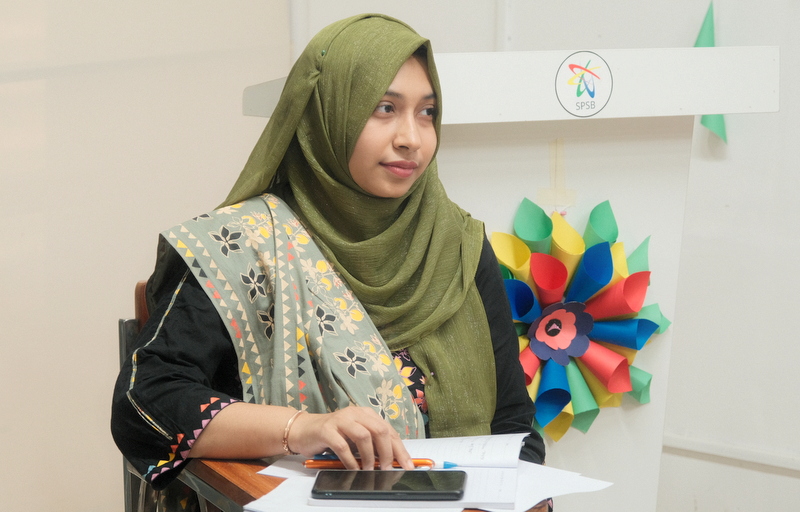
A mentor present at the event identified several underlying reasons behind the challenges faced by female freelancers:
- Lack of access to mentors
- The constant pressure to balance work, household responsibilities, and childcare
- Working from home requires women to manage family duties alongside professional tasks, limiting their ability to dedicate focused time to work
6. Gender-Specific Challenges
All participants unanimously agreed that it is extremely difficult for women to fit into any profession. Women are expected to manage household responsibilities alongside their careers. If a child becomes ill, it is considered an unwritten rule that the mother must take leave from work.
Mental health concerns are often ignored, as families tend to equate physical capability with overall well-being. Due to a lack of family support, many women drop out of freelancing even after entering the field.
The absence of quality daycare centers in Bangladesh was identified as a major barrier. Mothers are often unable to allocate sufficient time to work due to childcare responsibilities.
Women also tend to remain financially dependent on parents before marriage and husbands after marriage, with limited encouragement to pursue independent career growth.
While freelancing is considered suitable for women because it allows working from home, this same factor often leads to dropouts. Even when both spouses are freelancers, women are expected to work from confined spaces while simultaneously caring for children. Freelancing is frequently not recognized as “real work” by families.
7. Clients, Payments, and Cybersecurity
Participants reported that local clients often offer lower payments while exerting excessive pressure. Internet connectivity issues were also raised, with one participant reporting extremely slow internet speeds after 2 a.m. despite changing broadband providers multiple times.
Fraud through Facebook-based work was commonly reported, including non-payment after project completion. Participants noted that this issue affects both men and women and is primarily associated with local clients.
Cyberbullying was a major concern. Participants reported inappropriate language, unsolicited video calls, and harassment, which they attributed to their gender. While established platforms take strong actions against such behavior, incidents are more common when work is sourced through social media.
A mentor emphasized the importance of written agreements, noting that verbal payment deals often lead to fraud. However, one freelancer stated that even with documented email and chat records, effective remedies were not always possible.
8. Payment Gateways and Economic Impact
Participants reported losing international clients due to the unavailability of PayPal in Bangladesh. Some clients trust only PayPal and refuse alternative gateways. However, many freelancers rely on platforms such as Payoneer to receive payments.
Despite these challenges, freelancing has helped women achieve financial independence, support their families, and improve confidence and negotiation skills.
9. Government Support and Training
Government-led training programs were viewed as beneficial but in need of quality improvement. Participants highlighted the Her Power Project, which provides laptops to trainees, enabling them to start freelancing careers.
10. Motivation, Support Systems, and Recommendations
Family support especially from husbands for married women was identified as the most crucial factor for sustaining freelancing careers. Participants reported being inspired by other women who successfully earn from home.
Key recommendations included:
- Establishing mentorship programs for female freelancers
- Improving access to quality training and reliable institutions
- Expanding quality daycare facilities
- Raising awareness within families and society about freelancing as a legitimate profession
- Formally recognizing freelancing as a profession
- Providing dedicated workspaces for women freelancers
Conclusion
The FGD highlights that while female digital freelancers in Bangladesh make significant contributions to the digital economy, they continue to face systemic, social, technological, and gender-based challenges. Addressing these issues requires coordinated efforts from families, communities, government bodies, and digital platforms to ensure sustainable and inclusive growth of women’s participation in freelancing.