
Introduction
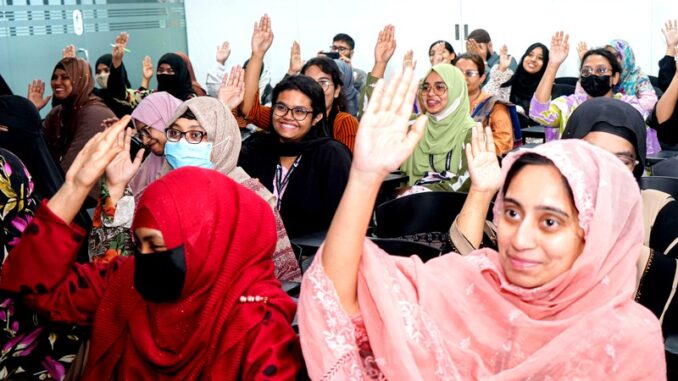
Bytesforall Bangladesh in collaboration with Bangladesh Open Source Network (BDOSN), organized a remarkable survey with female freelancers in Bangladesh to understand their rights, opportunities, contribution and challenges. This survey, the first of its kind, was open for 3 months only for female freelancers from November 2025 till January 2026. They survey was responded by more than 100 female freelancers. Following are some of the results and overviews of this survey, including a comparative analysis of different variables.
Dataset Overview
- Total observations: 101 female freelancers
- Total variables: 65 survey questionnaire
- Survey time: November 2025 – January, 2026 (3 months)
- Variable types:
- Demographic: age, education, marital status, location
- Professional: freelancing experience, income, working hours, clients
- Skill development: training, certifications
- Social factors: family support, social recognition, gender bias
- Challenges: technological, payment, online safety
- Comparative analysis of various variables with correlation, causation, socio-economic pattern and policy implications
1. Demographic: age, education, marital status, location
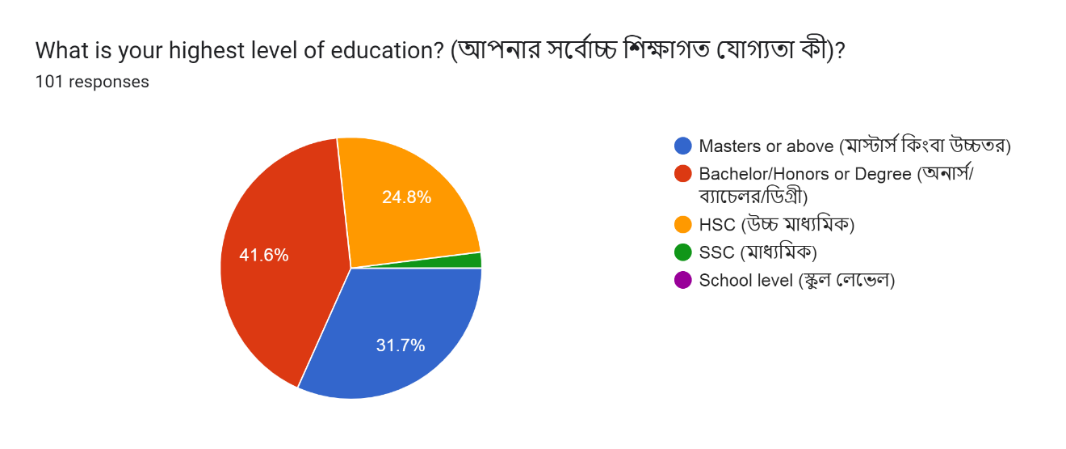
Total 101 practicing freelancers participated this survey. As per the figure (1.1) below, a large number of them have post-secondary education (almost 66.4%), indicating that most of the respondents who have higher education choose freelancing as their profession.
Figure 1.1
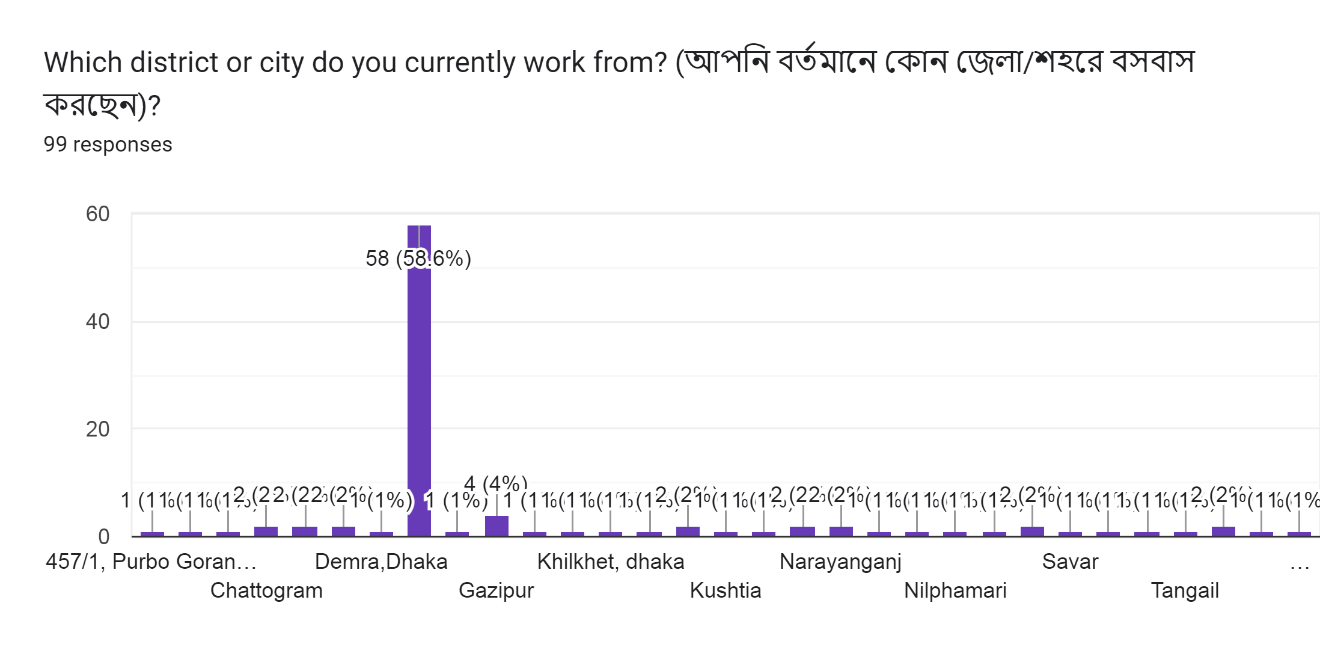
Its not surprising that majority of them work and are from Dhaka, the capital city of Bangladesh.
Figure 1.2
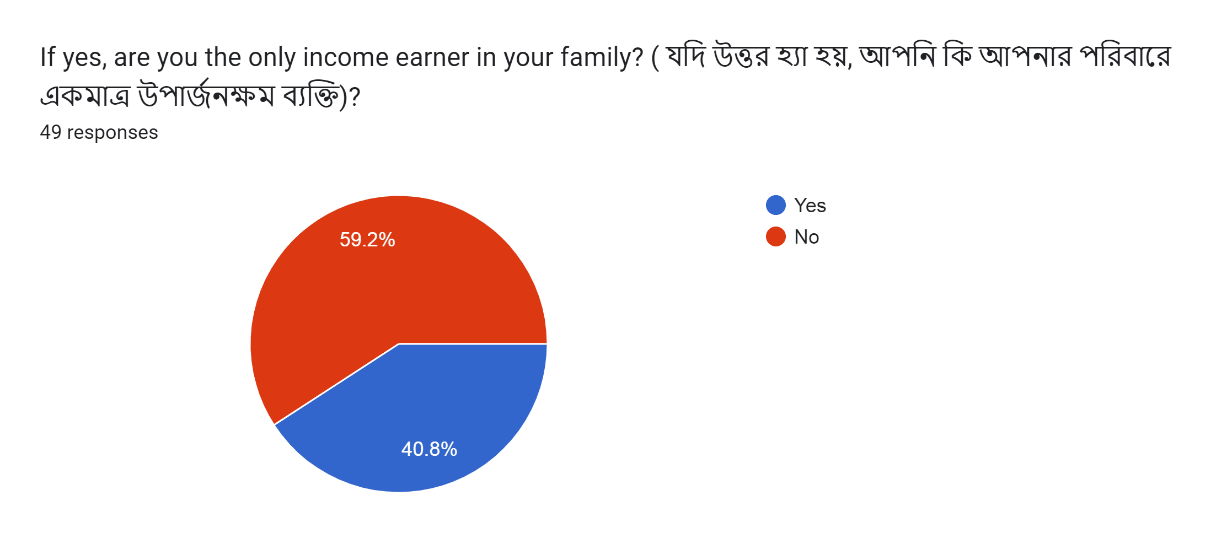
As shown in Figure 1.3, a good number of the respondents (55.4%) were married meaning many of them also have family related responsibilities, which is also reflected in Figure 1.4 and 1.5. A large number of respondents (48.5%) says that they have to contribute their income to their families and in almost 40.8% case (Figure 1.6), they are the sole income earner.
Figure 1.3
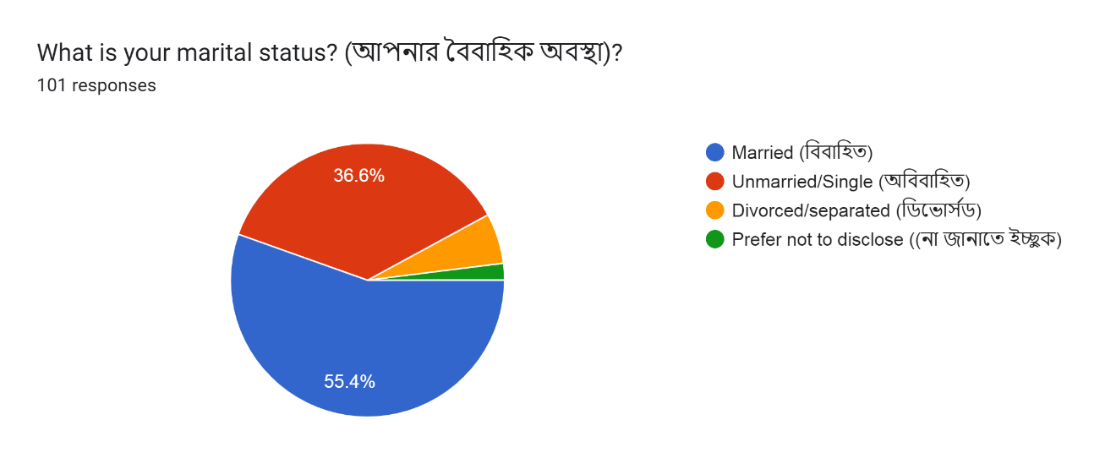
Figure 1.4
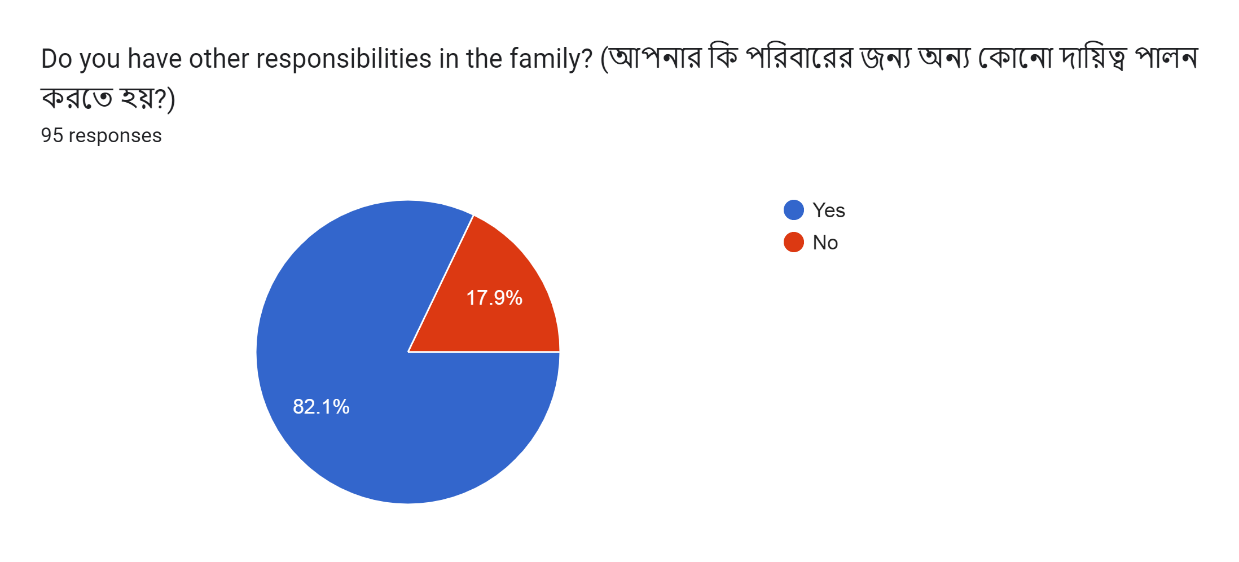
Figure 1.5
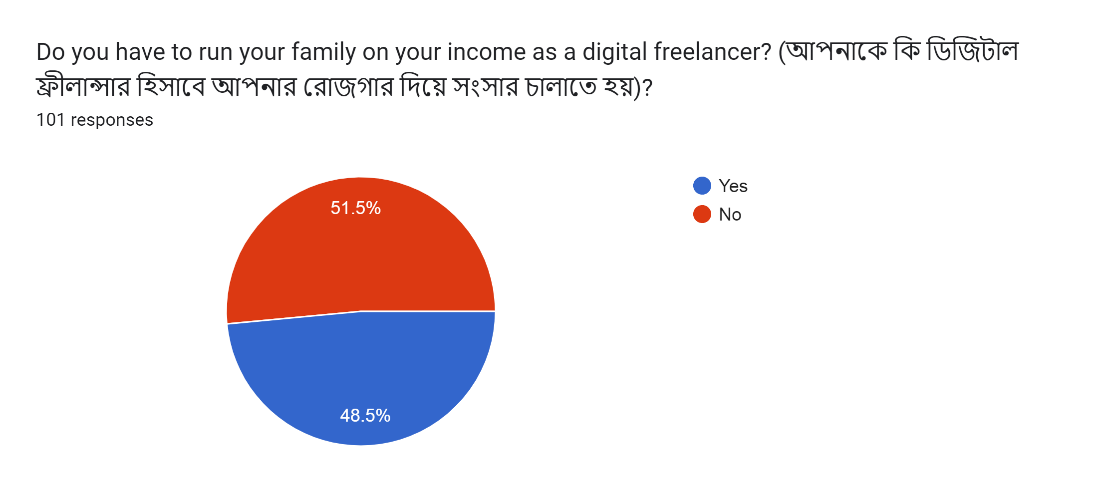
Figure 1.6
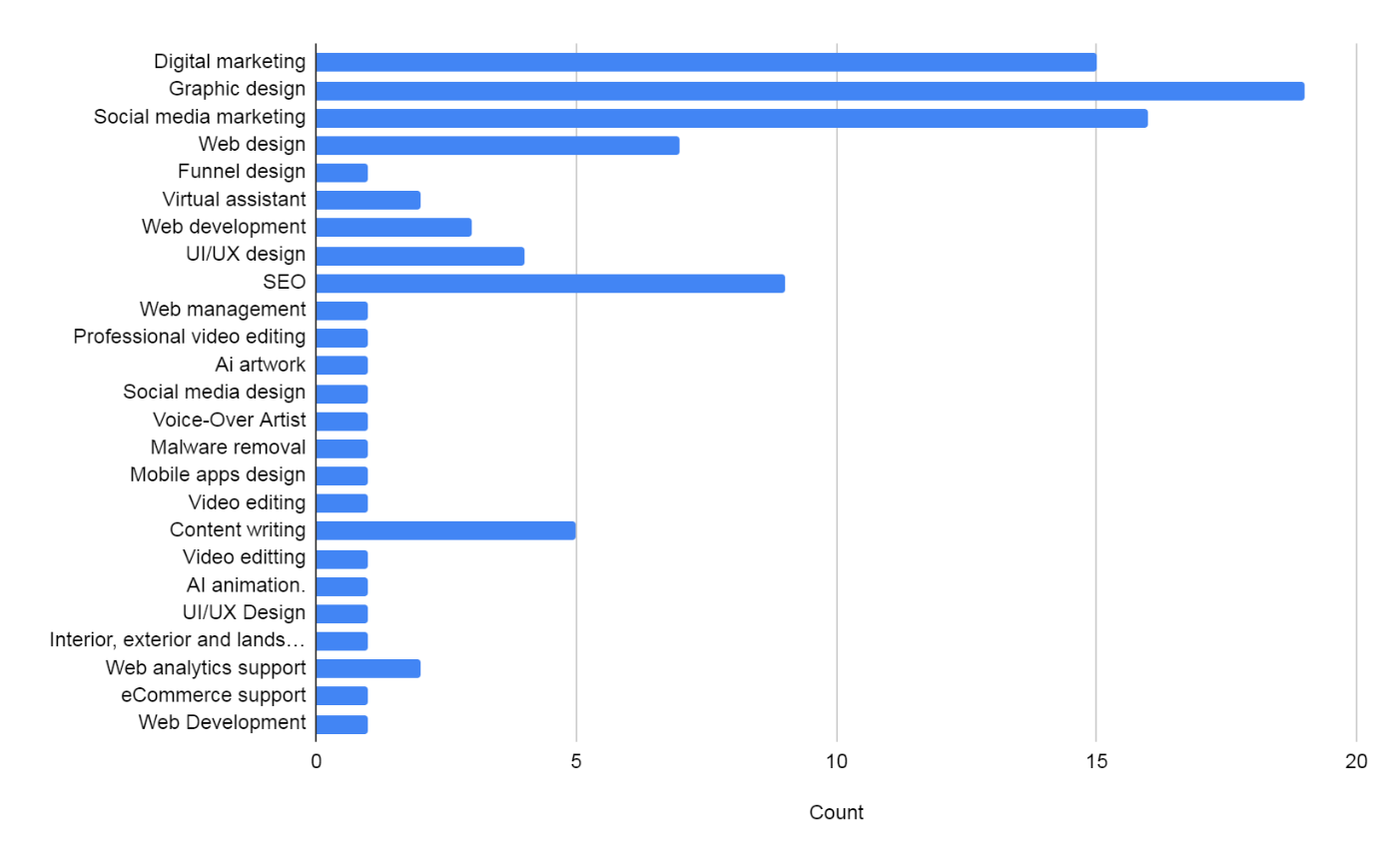
Following chart (Figure 1.7) shows where they work or what their expertise are. It seems that they work mostly on digital marketing, social media marketing, graphic design, SEO, UI/UX design, content writing and web design areas.
Figure 1.7
2. Professional: freelancing experience, income, working hours, clients
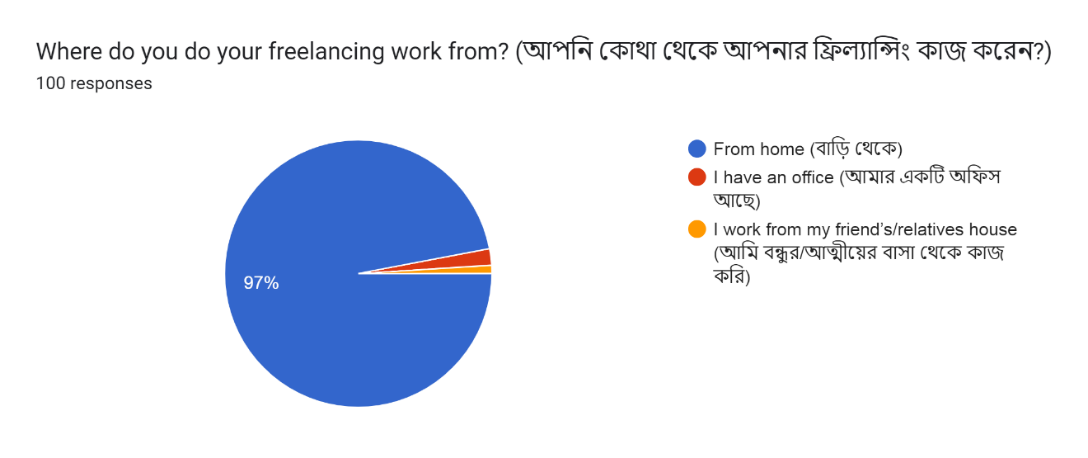
Majority of the freelancers (53%) do have experience more than 1 year (Figure 2.1) and they pre-dominantly work from home (Figure 2.2)
Figure 2.1
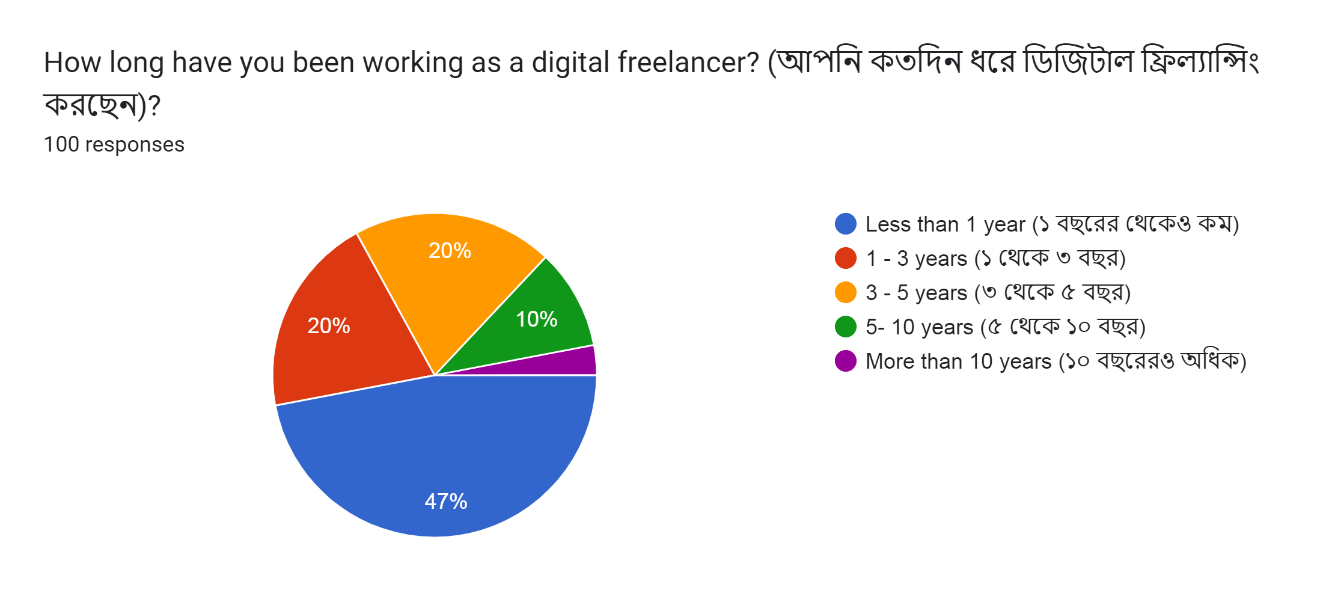
Figure 2.2
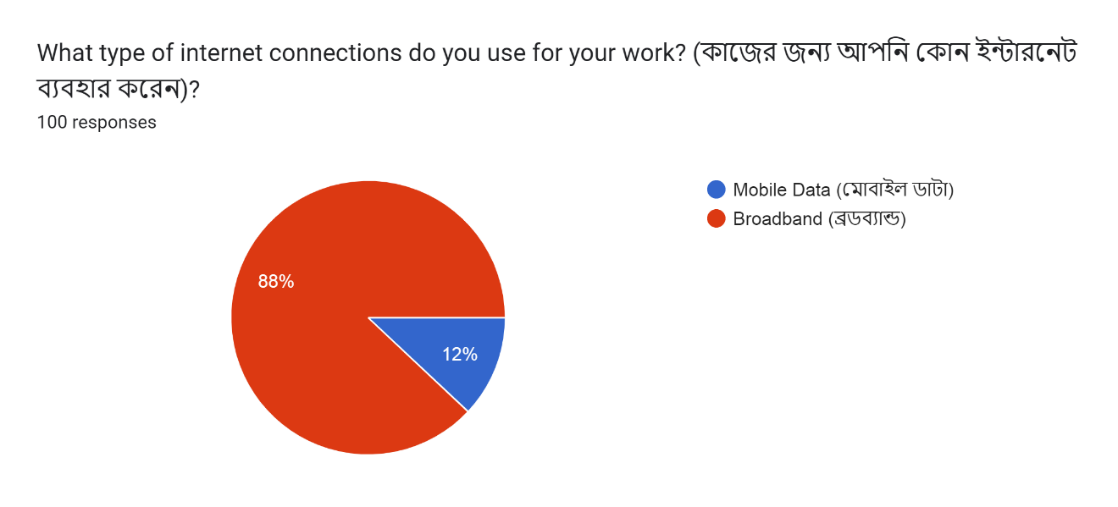
As shown in Figure 2.3 and Figure 2.4, they use laptop and broadband connection for their work.
Figure 2.3
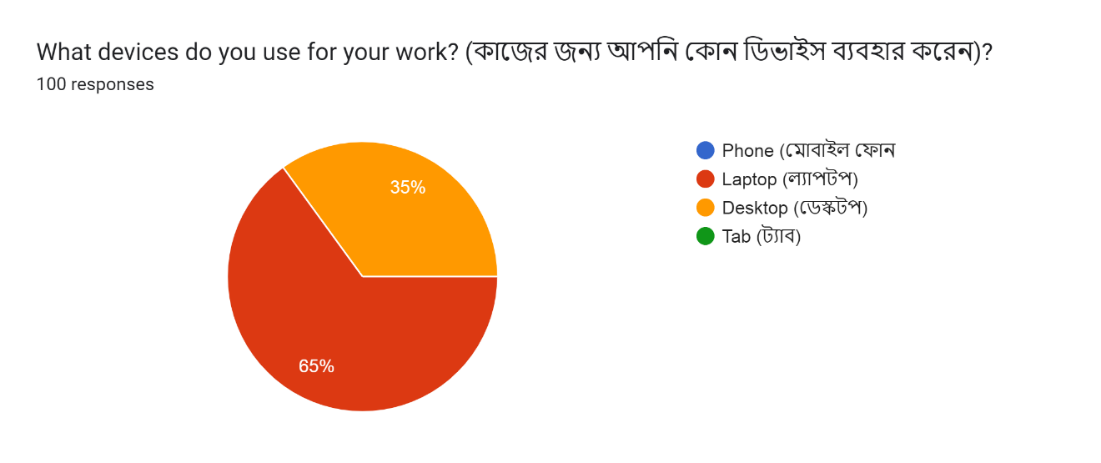
Figure 2.4
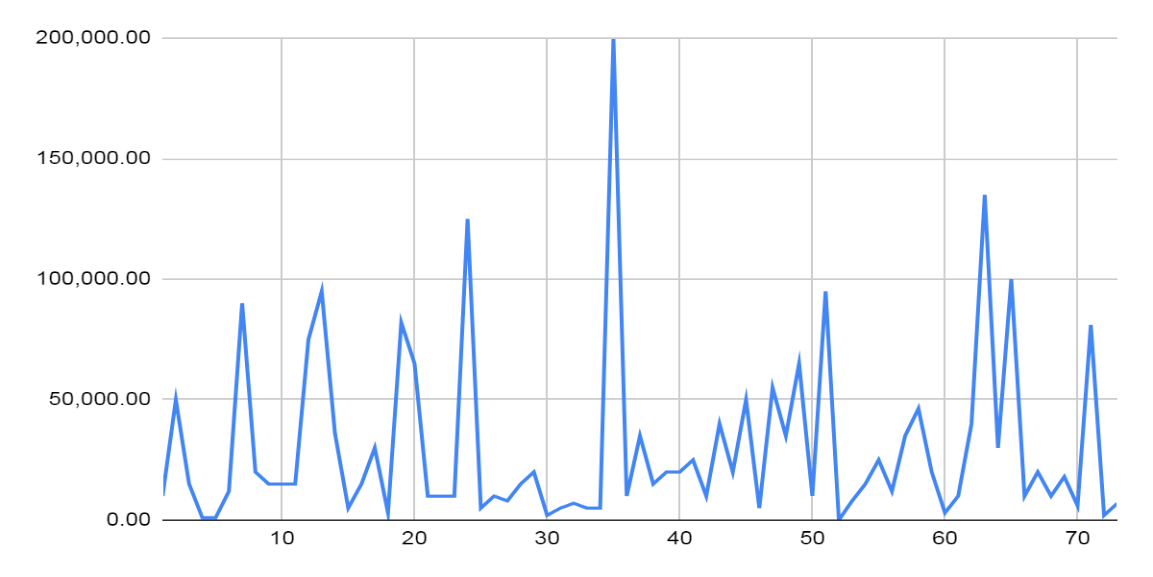
Their monthly income also varies as shown in the diagram (Figure 2.5) below with an average income of 30,000 Tk. (USD 250) per month.
Figure 2.5
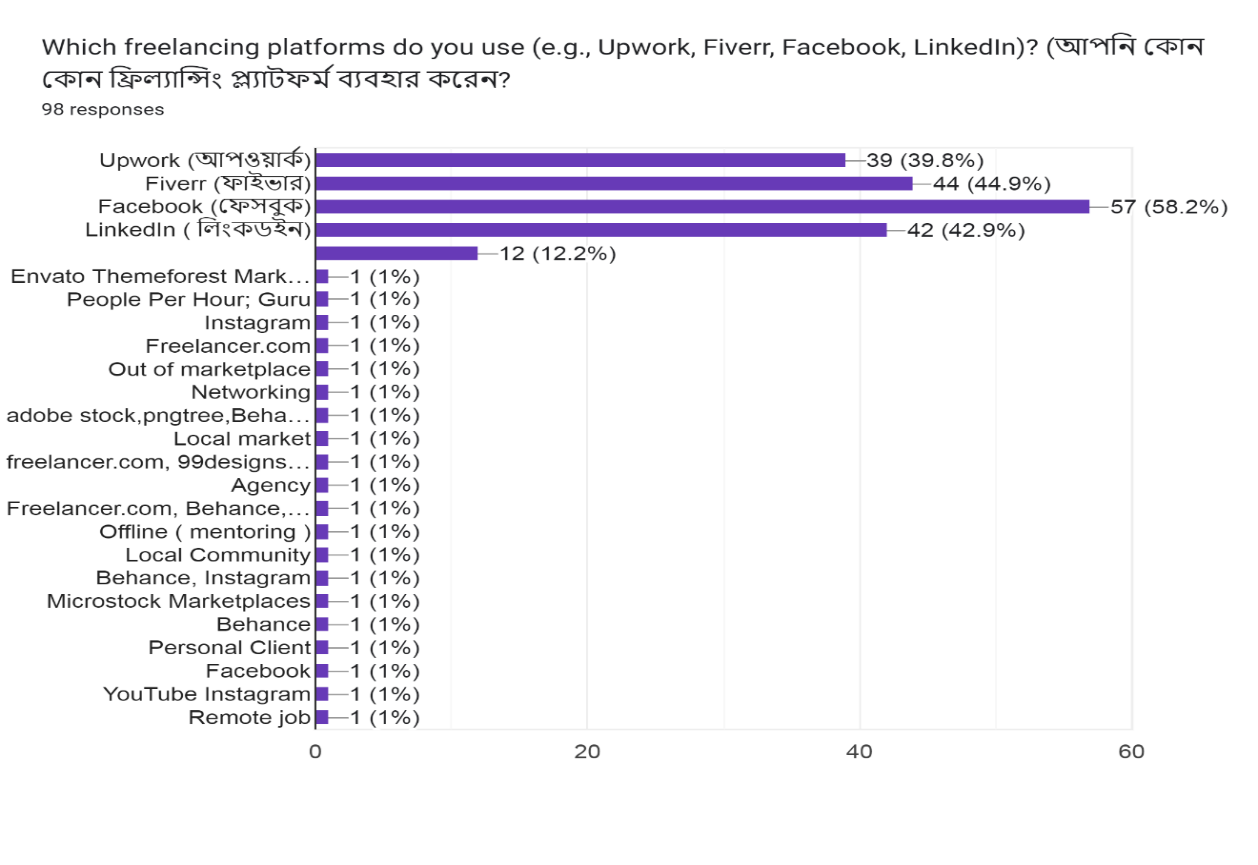
It seems that Facebook Marketplace (58.2%), followed by Fiverr (44.9%), LinkedIn (42.9%), Upwork (39.8%) etc. are the most popular platform for freelancing among the female freelancers (Figure 2.6).
Figure 2.6
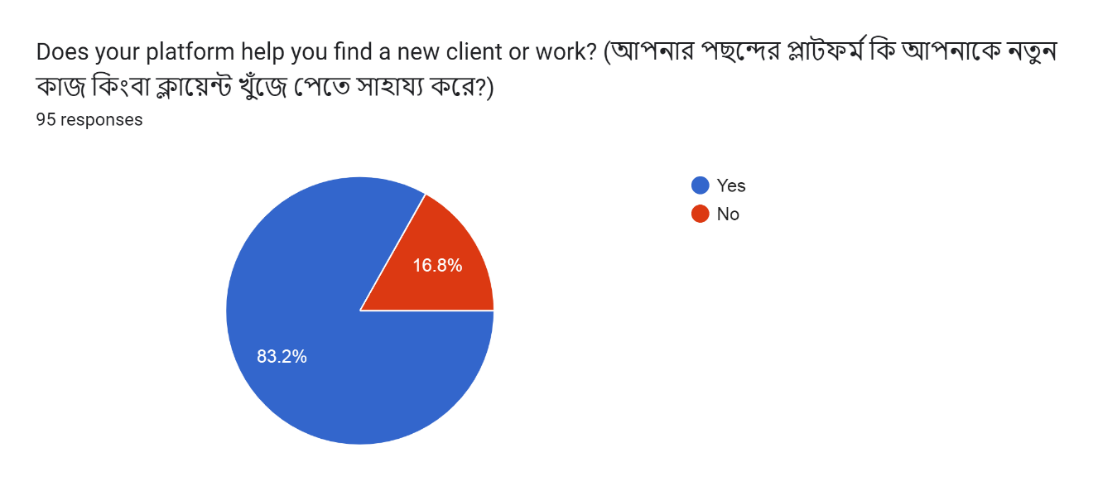
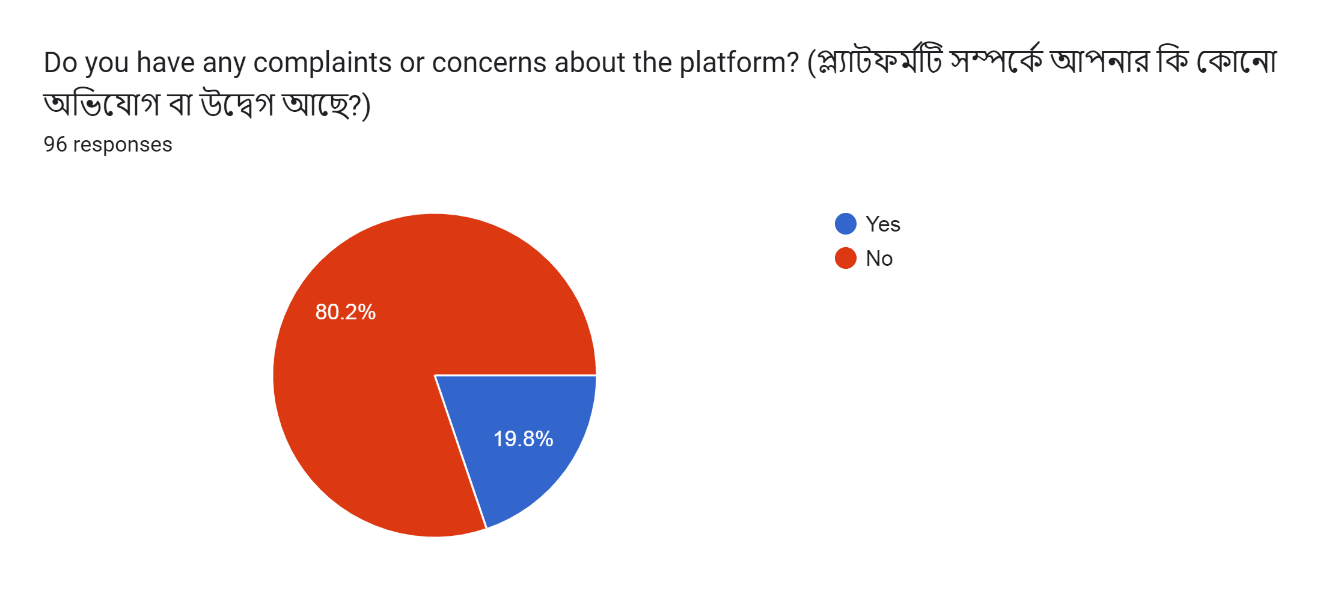
It seems that these platforms help them find the clients and new opportunities (Figure 2.7) and they do not have much complaints or concern on these (Figure 2.8)
Figure 2.7
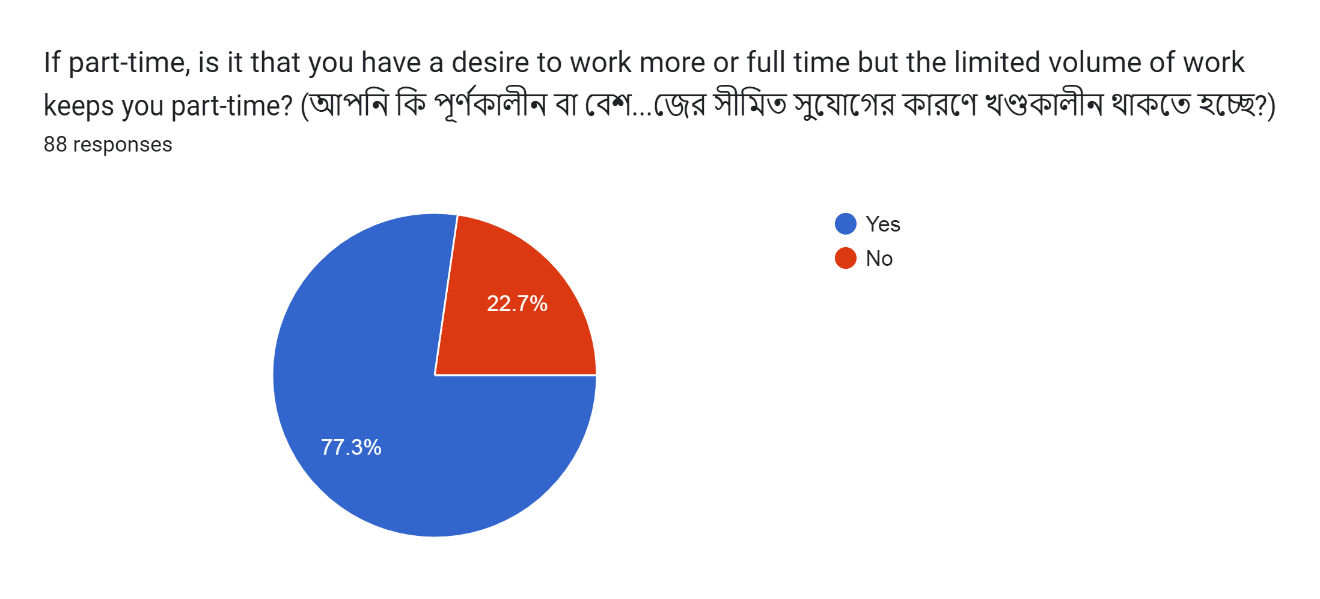
It seems that a good number of respondents work part-time (less than 7 hours) on freelancing (Figure 2.9) not because they don’t want to work full time. An overwhelming majority (82.8%) of them want to work full time (Figure 2.10), but the limited volume of work doesn’t allow them to work full-time (Figure 2.11).
Figure 2.9
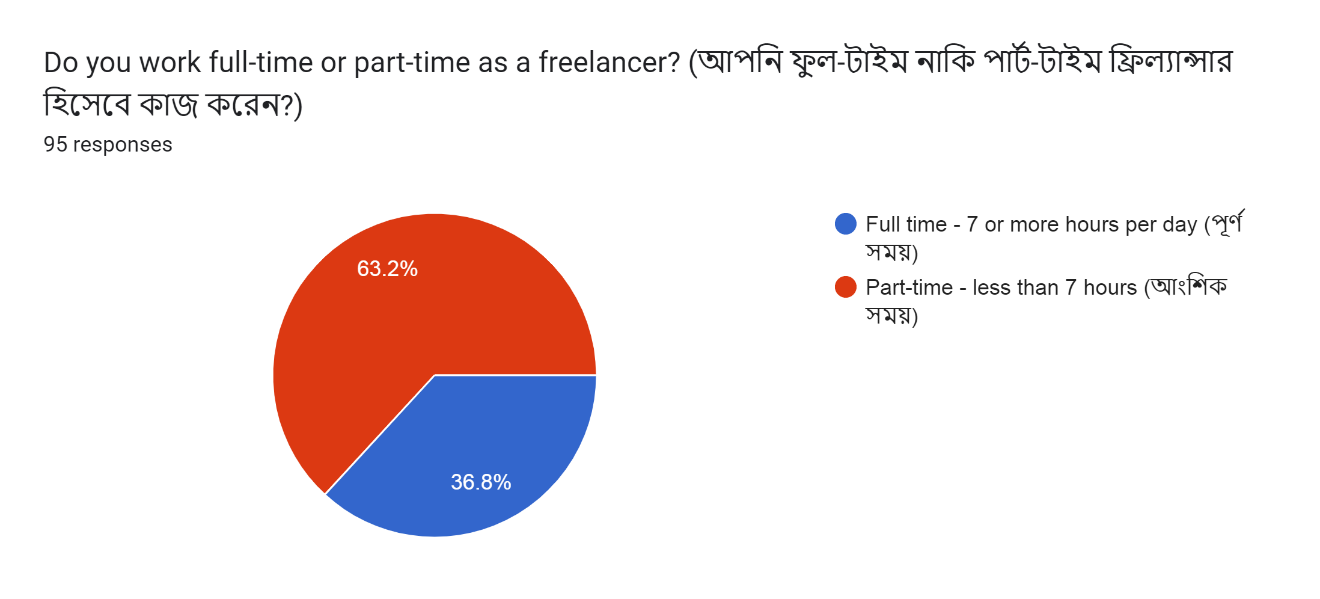
Figure 2.10
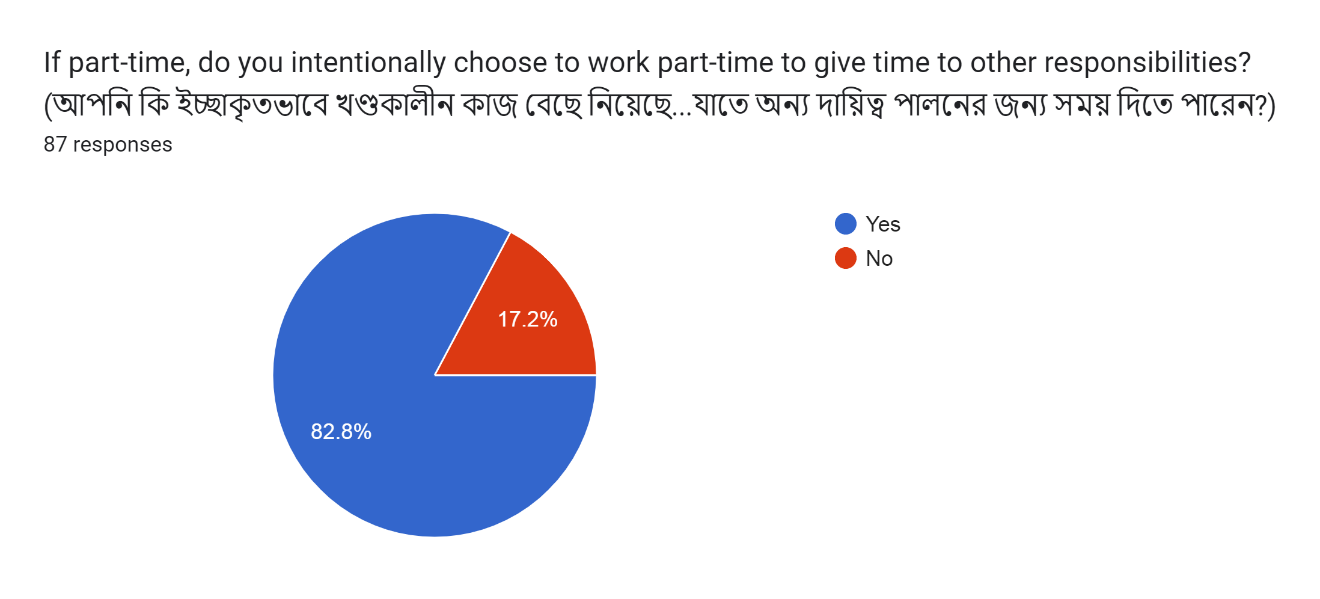
Figure 2.11
3. Skill development: training, certifications
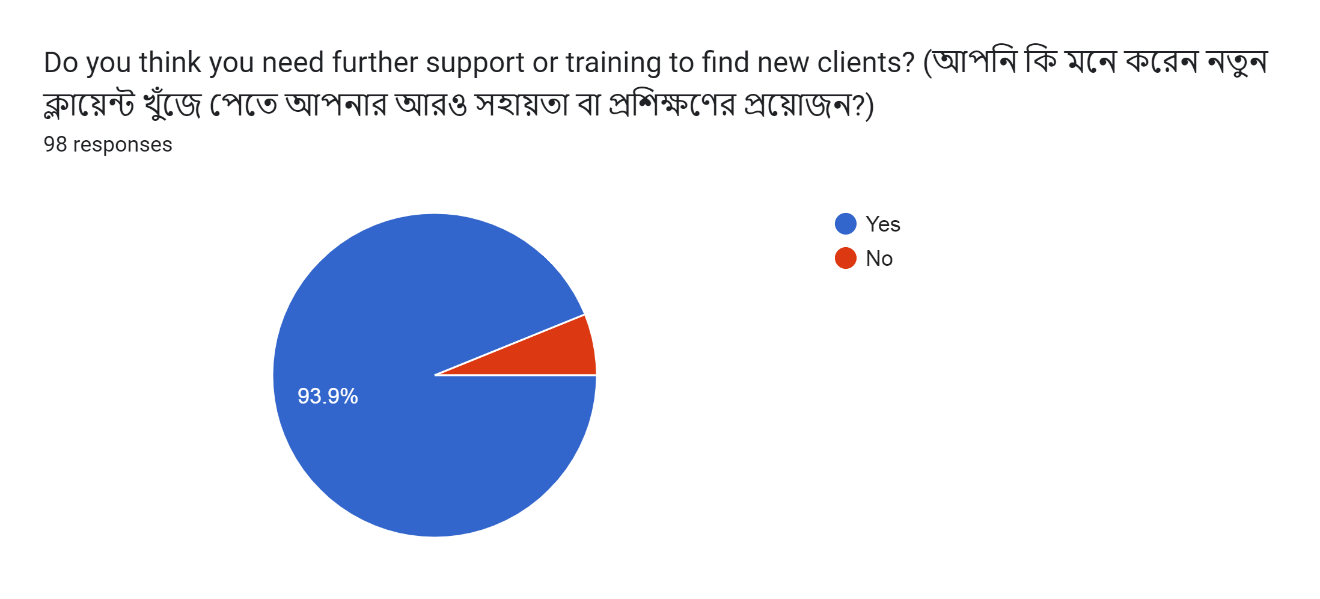
The survey also wanted to know the skills set, training and certification of these freelancers. Most of them (74%) have taken paid courses and training on the required fields of freelancing (Figure 3.1), followed by Government organized and fully supported training (36%). Interestingly, contrary to what many believe, 68.5% of them says that Government supported training programs were helpful for them (Figure 3.2) to an extent but they still need further training to improve their work and explore new and advanced opportunities, new clients etc. (Figure 3.3 and Figure 3.4)
Figure 3.1
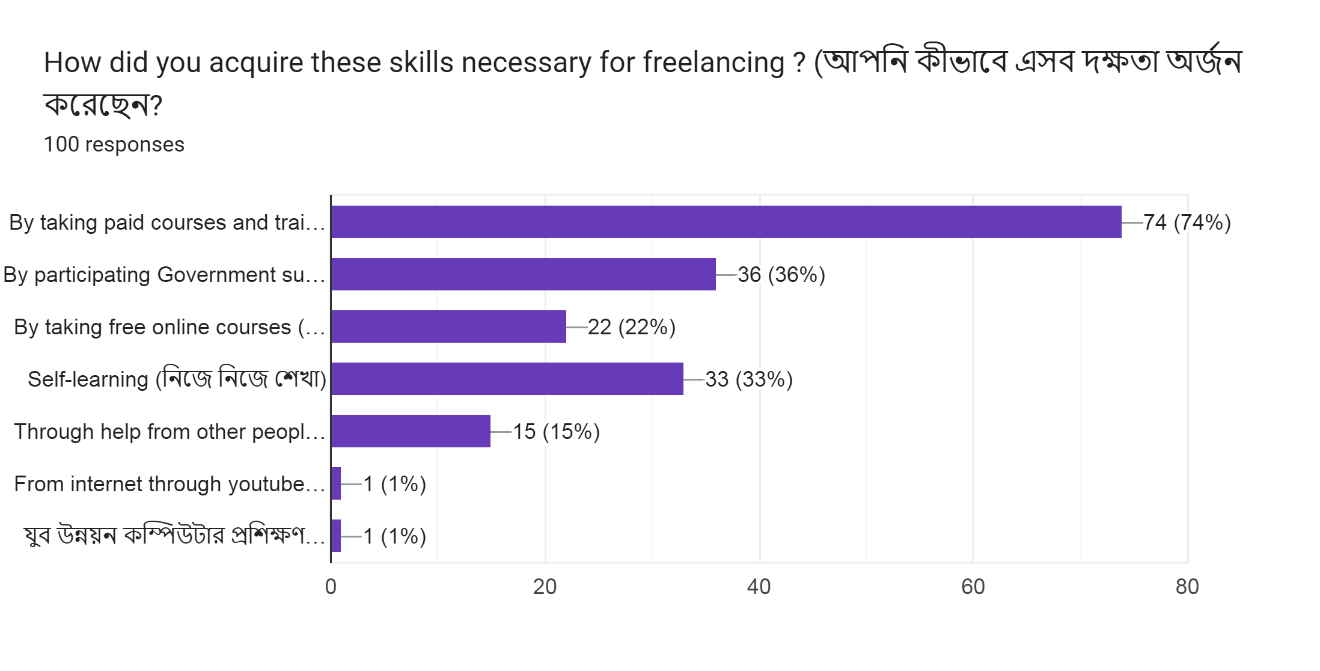
Figure 3.2
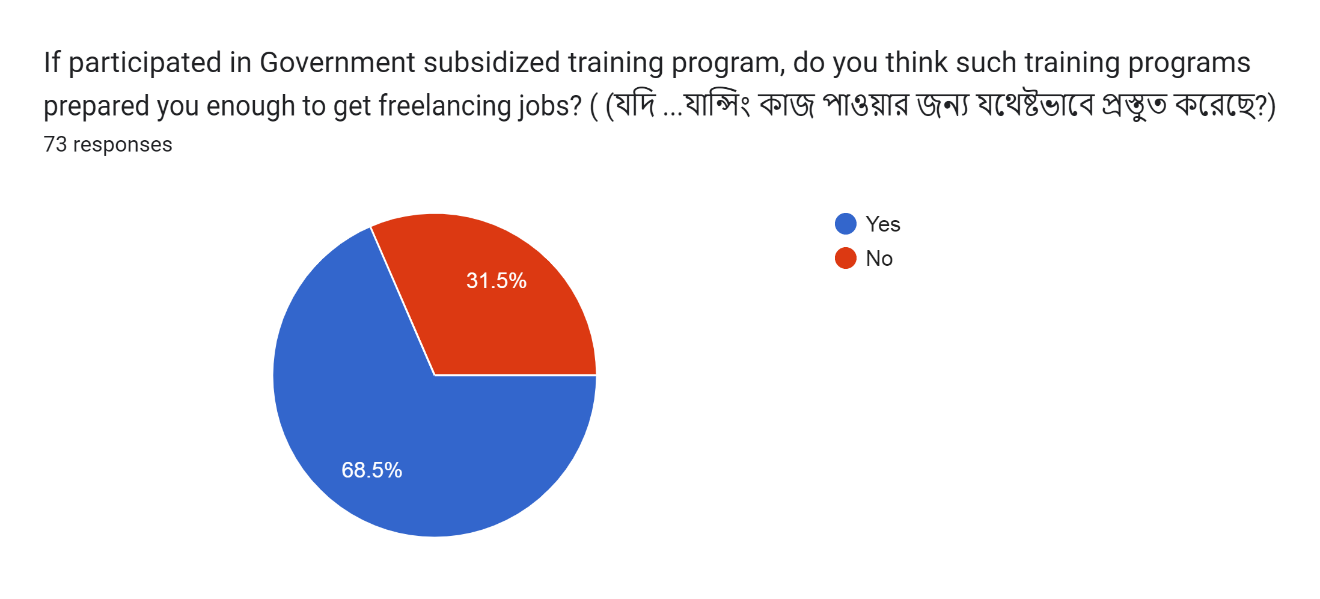
Figure 3.3
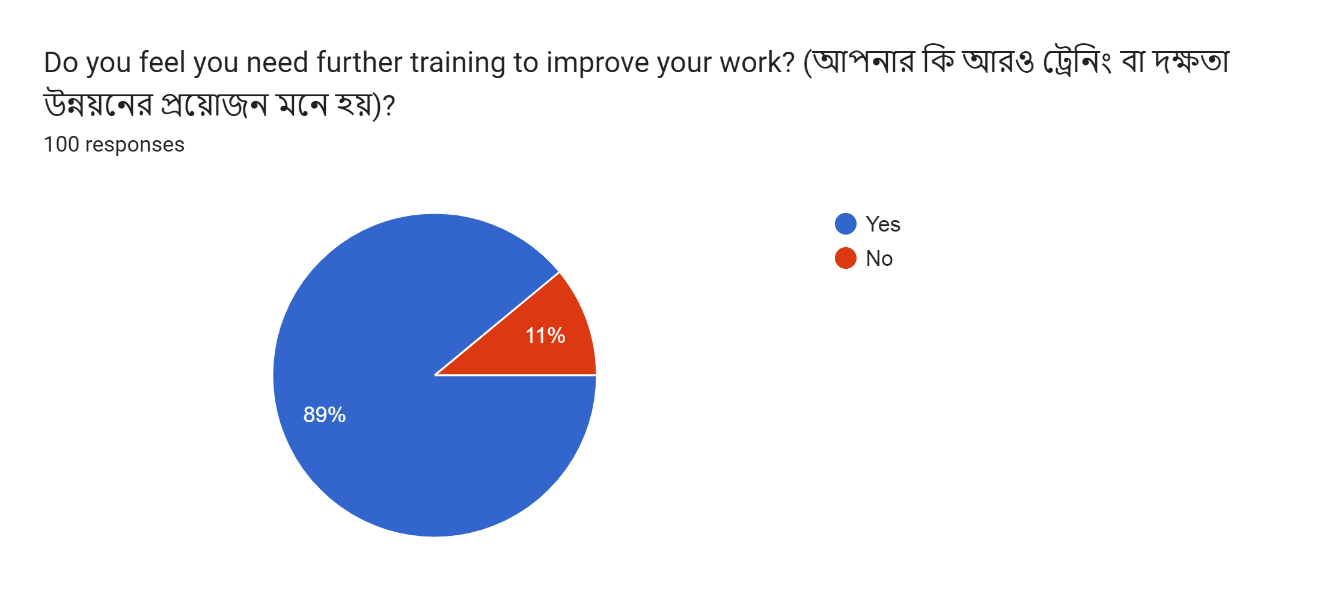
Figure 3.4
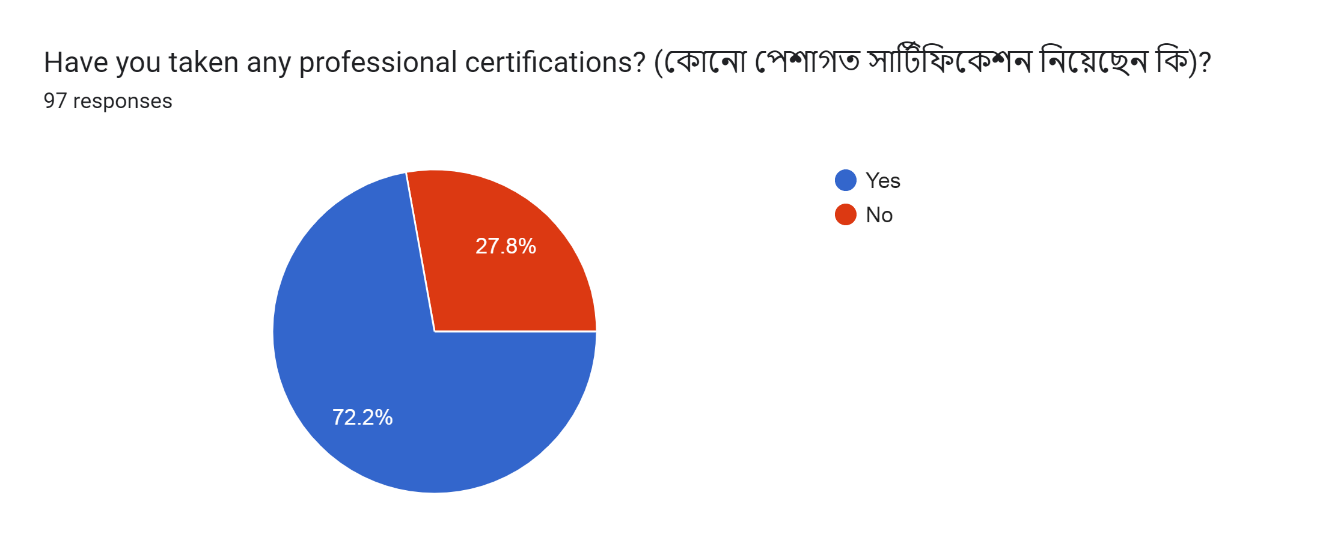
It is also evident that a good number of respondents (72.2%) do have professional certifications (Figure 3.5).
Figure 3.5
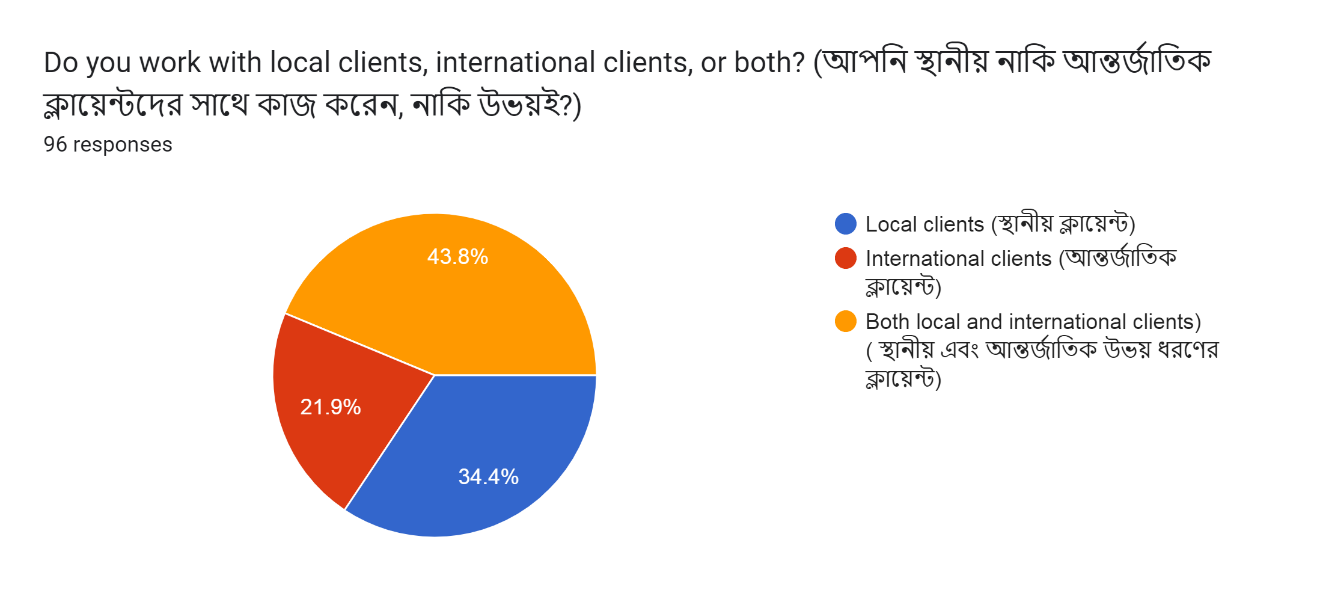
The survey also shows (Figure 3.6) a good number of the freelancers work with both local and international clients (43.8). A good number of others work either with local clients (34.4%) or with international clients (21.9%).
Figure 3.6
4. Social factors: family support, gender bias, social barriers
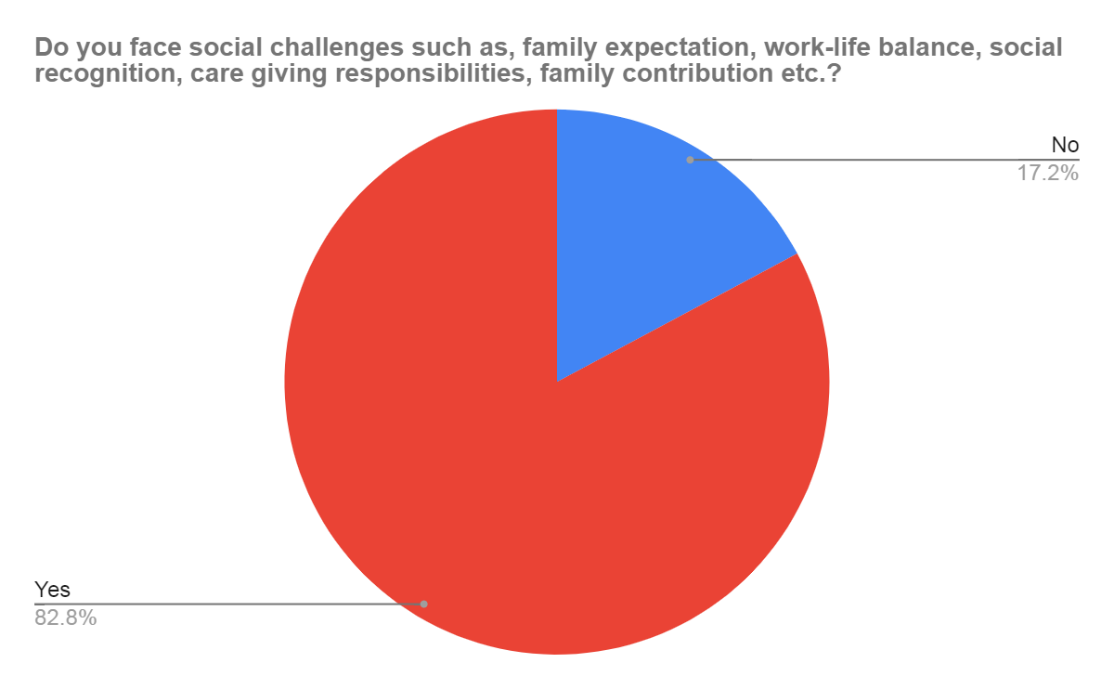
The survey respondents talked a lot about their social challenges including family support, work life balance, social recognition and other care giving responsibilities. Following chart 4.1 shows that, an overwhelming majority of the respondents (82.8%) told us that they face these challenges.
Figure 4.1
They also illustrated the nature of those challenges as well. Some examples include:
- “I always fight to maintain my family because i have 2 daughter i need to take care of them too.”
- “No one in my family supports me. My family members fight over my freelancing. So I can’t concentrate on completing my work. I have problems getting clients.”
- “Yes. When I started I became socially introverted and it costed me some personal and family relationships.”
- “As a single mother, a lot of time I cried because i don’t get time to sleep or rest.”
- “There may be expectations to manage household tasks alongside work, and achieving work-life balance requires careful planning. Social recognition for freelancing work is still growing, which can sometimes make the profession less understood by others.”
- “Sometimes family responsibilities, like helping at home or supporting relatives, can overlap with work hours, making it necessary to manage time very carefully.”
- “I face some social challenges while freelancing. My family sometimes expects a fixed income like a regular job, and it can be hard to maintain work-life balance since I work from home.”
- “Taking care of family alone with work can lead to a loss of time balance.”
- “I’m mother of two child’s. Due to family responsibility I can’t work more time, on the other hand money is important for living hood.”
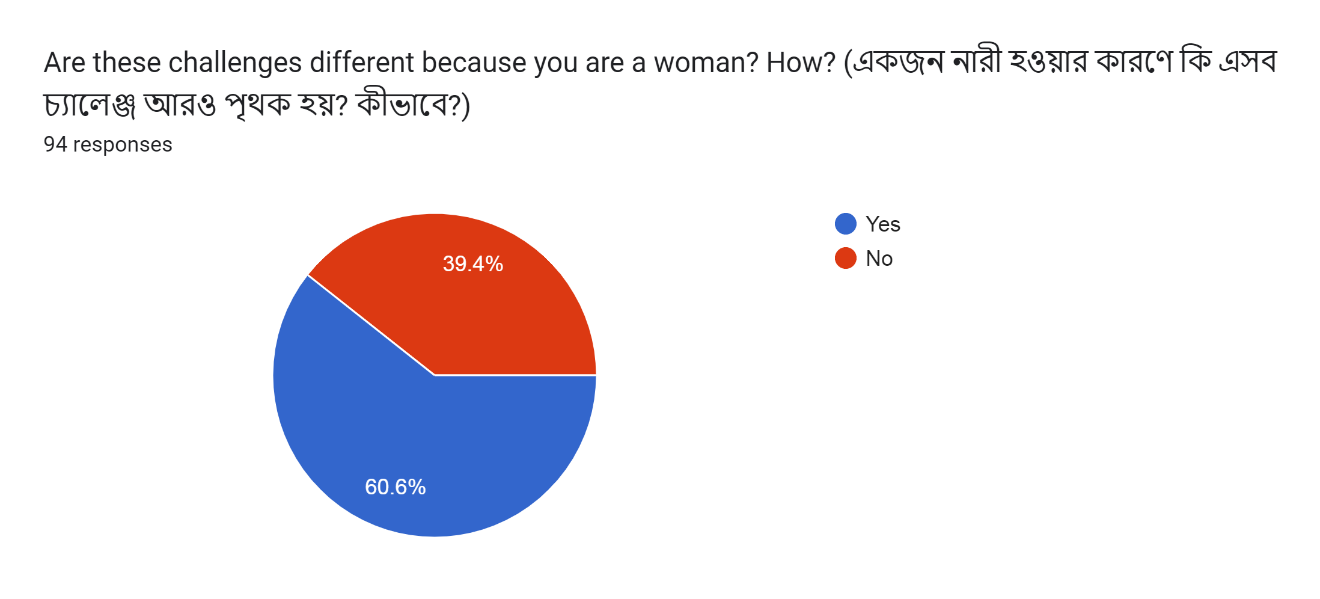
A good majority (60.6%) think that these challenges exist mostly because they are women (Figure 4.2).
Figure 4.2
5. Challenges: technological, payment, online safety
Apart from family or society related challenges, we also wanted to see the other types of challenges (such as, wage discrimination, non-payment or delayed payment of work, online or workplace harassment, workload etc.).
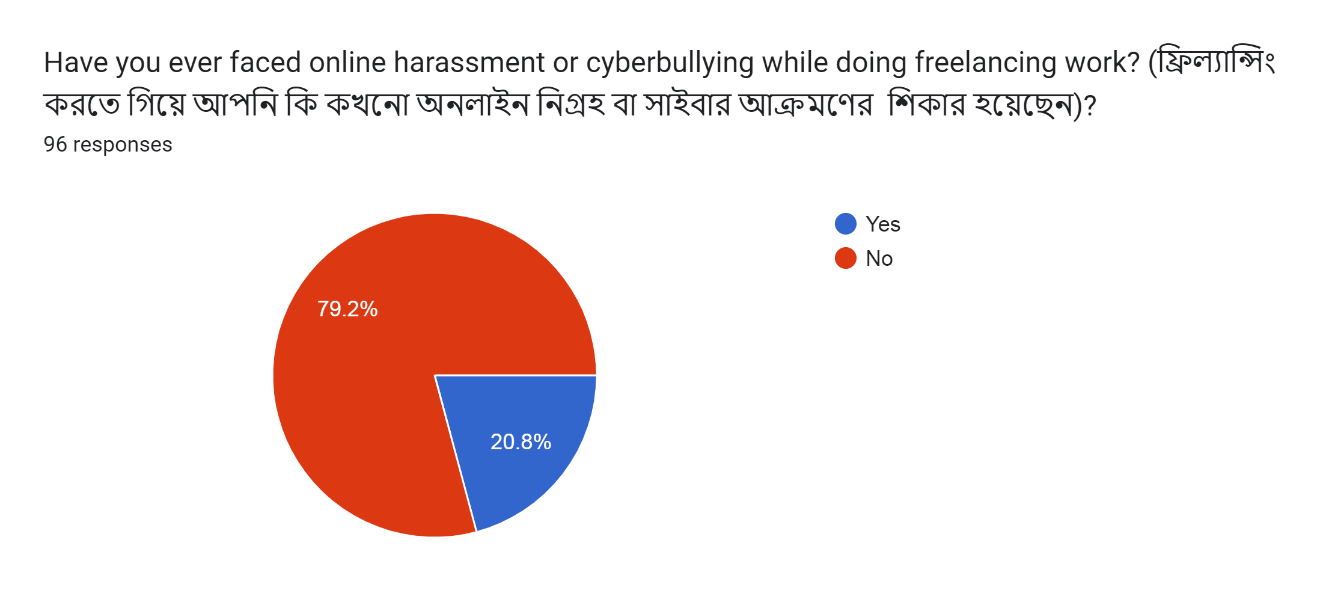
A segment of the respondents (20.8%) say that they faced online harassment or cyber bullying while doing their free lancing work (Figure 5.1).
Figure 5.1
It seems that majority of them never reported such problem to anywhere. Many are even unaware of places or processes to report. While reporting is scarce, understanding, practices and actions for online safety seem to be visible among the respondents. Following are some interesting insights from them:
- “I use strong passwords, two-factor authentication, secure devices, and avoid sharing personal information to stay safe online.“
- “I don’t share my personal thoughts while working with clients. I try not to react when someone is not understanding and I try my level best to accommodate clients with their needs. I don’t use my personal accounts and try to use separate email accounts so that i can maintain my privacy.”
- “I check the profile of the person who sent the message first and then reply to the SMS.“
- “I always focus on safe conversation with clients, so that any one won’t have any chance to find fault in my deal.“
- “Being mindful before uploading anything.“
- “I prioritize online safety through Two-Factor Authentication (2FA) on Upwork and my banking apps. I use unique, complex passwords managed via a password manager and strictly keep communications on-platform to avoid scams. Additionally, I use a VPN for secure connections and maintain a “3-2-1” backup strategy for client files to ensure data is never lost due to hardware or power issues.“
One of the major issues that has come up in this survey, is the payment issue, for which female freelancers suffer a lot. Following are some of the comments from the respondents.
- “Payment: Most of the clients use paypal and our country does not support this payment method.”
- “Payment method – Most of them ask for wise and paypal for payment.”
- “Sometimes clients are not responsive immediately, or they may hesitate to approve ads and campaigns. Payments can also be delayed occasionally, and managing multiple projects at once requires careful planning and time management.“
- “The main problem i faced that it delays on payment.”
- “Main problem is taking payment outside marketplace. There is no proper gateway in Bangladesh that Foreign clients are familiar with to pay like Paypal.“
- “As a freelancer, I sometimes face challenges with client communication, payments, and workload management. Communication can be tricky when working across different time zones, which requires flexibility and clear scheduling. Payment delays or disputes occasionally occur, but I rely on secure freelancing platforms to minimize risks.“
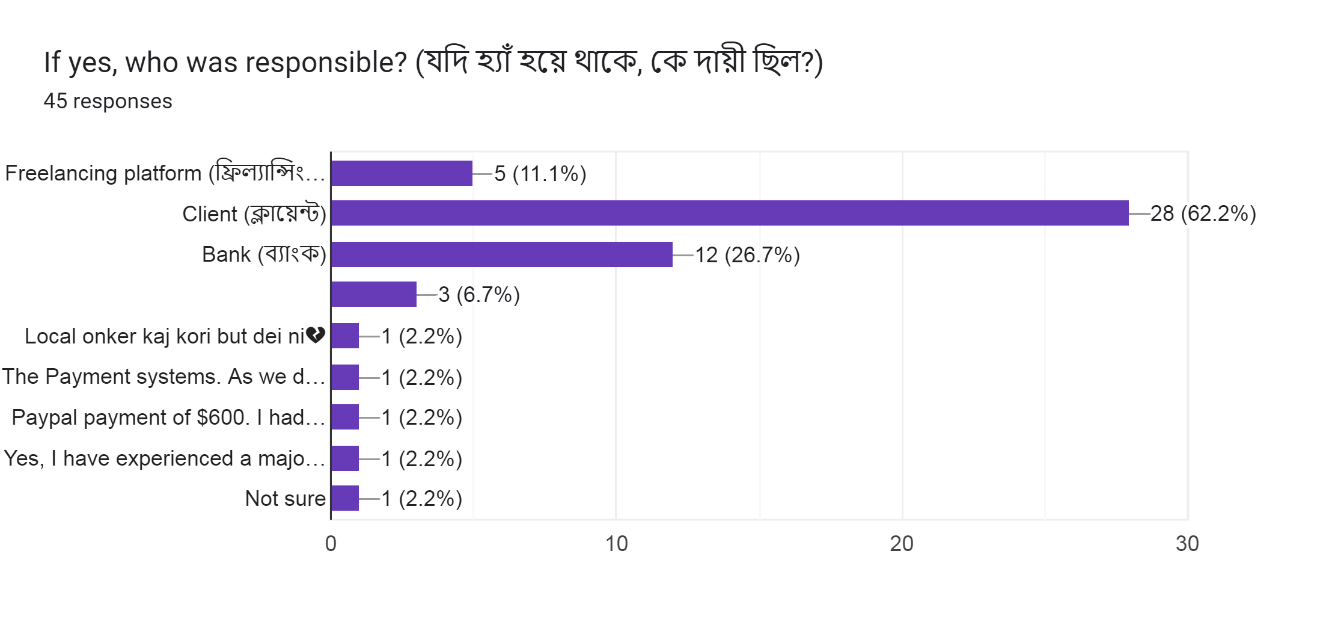
For non-payment or payment delay issues, we tried to understand who is responsible for that. They think it’s the client and the banks who are mostly responsible (Figure 5.2)
Figure 5.2
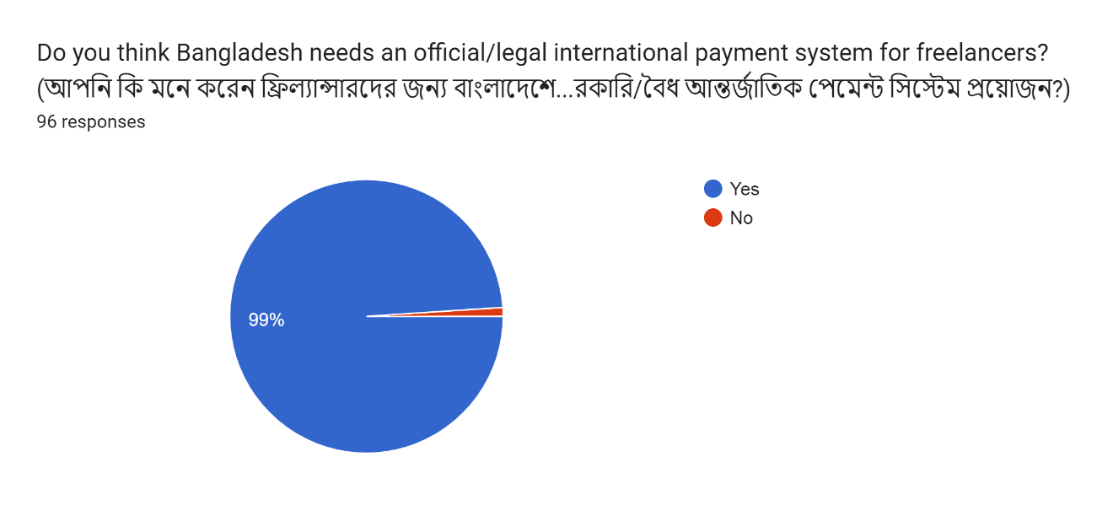
But one thing is clear from the survey that almost all the female freelancers want an official/legal international payment system in Bangladesh for an easy and smooth transfer of payment (Figure 5.3)
Figure 5.3
6. Comparative analysis: few insights
Correlation:
The dataset suggests that there is a strong correlation between financial contribution and family recognition.
Financial contribution → Family recognition
This suggests that economic contribution improves social acceptance of women freelancers in households.
Socio-Economic Patterns in the Dataset
The data set also suggests some socio-economic patterns.
Age Distribution
Most female freelancers fall in the young adult category (18–30), suggesting freelancing is largely a youth-driven digital workforce activity.
Education
The majority possess undergraduate or postgraduate education, showing that freelancing attracts relatively educated women.
Work Mode
Many respondents work part-time, often due to:
- household responsibilities
- caregiving
- lack of continuous client work
Key Challenges Identified
From qualitative responses in the dataset, we could identify following barriers.
- Technological barriers
- Slow internet
- Limited access to high-performance devices
- Software costs
- Payment barriers
- Delayed payment
- Limited international payment options in Bangladesh
- Delayed payment
- Social barriers
- family expectations
- work-life balance pressure
- limited recognition of freelancing as “real work”
- Gender-specific barriers
- lower wage offers compared to male freelancers
- clients questioning their expertise
- online harassment
Evidence of Gendered Digital Labor
The dataset reveals several gender-specific patterns:
- Care Work Burden: many freelancers choose part-time work to manage family responsibilities.
- Social Recognition
- Recognition is often conditional:
- Women gain more respect after contributing financially to the household.
- Platform Dependency
- Most freelancers rely on platforms such as: Upwork, Fiverr
- Social media: This creates platform-mediated labor dependency.
Causation Interpretation
While correlation does not prove causation, the data suggests several probable causal pathways.
Pathway 1
Freelancing income
→ financial contribution to household
→ increased family respect and recognition
Pathway 2
Training and skill development
→ better freelancing opportunities
→ higher income potential
Pathway 3
Family responsibilities
→ part-time freelancing
→ lower earnings potential
Policy Implications
The dataset indicates several policy priorities for supporting women freelancers.
Government
- Develop legal international payment systems
- Expand freelancing training programs
- Provide subsidized internet access
Platforms
- Improve client dispute resolution
- Protect freelancers from online harassment
Society
- Encourage shared family responsibilities
- Recognize freelancing as a professional career